

What Is Data Center Infrastructure?
The physical foundation beneath every cloud platform, AI model and digital service.
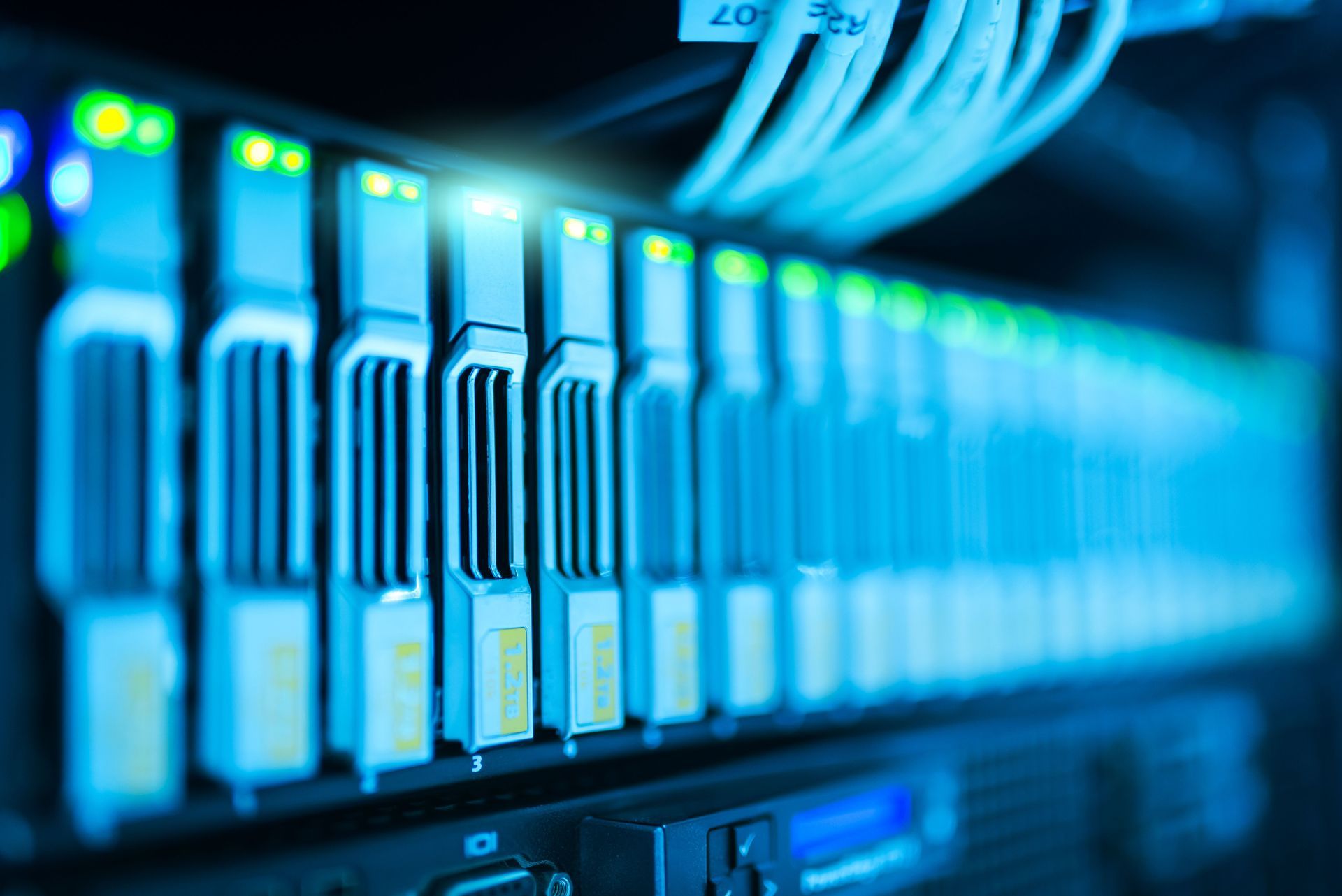
Data Center Infrastructure - Compute, Power, Cooling and the Physical Layer of the AI Economy
Data Center Infrastructure is the physical and technical systems that house, power, cool, secure and connect the computing resources behind cloud, AI and digital services.
It includes the hardware, facilities and operational systems that allow servers, storage and networking equipment to run reliably at scale.
Data center infrastructure can encompass:
- compute servers and racks
- storage systems
- networking equipment
- power distribution infrastructure
- cooling systems (air and liquid)
- physical security systems
- data center infrastructure management (DCIM) software
- backup power and generators
- fire suppression and environmental controls
- modular and prefabricated data center units
The category spans enterprise, colocation, hyperscale and edge deployment types, and touches nearly every industry — technology, finance, healthcare, government, telecommunications and manufacturing.
The terminology is fully established across the industry. Multiple independent market research firms — including Coherent Market Insights and Precedence Research — track "Data Center Infrastructure" as a defined, multi-hundred-billion-dollar global market category, distinct from but closely related to the broader "AI Data Center" market.
Why Data Center Infrastructure Matters
Every AI model, every cloud application, every enterprise workload ultimately depends on physical infrastructure somewhere.
A generative AI request may depend on:
User
↓
Application
↓
Cloud Platform
↓
Data Center
↓
Compute (GPU/CPU)
↓
Power & Cooling
↓
Physical Facility
Every layer depends on the infrastructure beneath it.
The growth of generative AI, cloud migration, and enterprise digitization is driving unprecedented demand for data center capacity — and the physical constraints of building that capacity (power availability, land, cooling, chip supply) have become one of the defining bottlenecks of the AI era.
The Scale of Current Investment
The scale of capital moving into this category is difficult to overstate.
- The global data center infrastructure market is valued at approximately $342.5 billion in 2026, projected to reach $1.13 trillion by 2035.
- A separate, AI-specific segment of the data center market is projected to grow from $22.26 billion in 2026 to nearly $197.57 billion by 2035.
- McKinsey research estimates global investment in data center infrastructure could reach nearly $7 trillion through 2030, with more than $5 trillion tied specifically to AI-related demand.
- Microsoft announced an $80 billion investment in AI data center infrastructure for its 2025–2026 fiscal year.
- Brookfield Infrastructure Partners and Data4 committed over $20.7 billion to AI-specific infrastructure across France.
- Bharti Airtel and Google announced a $15 billion investment (2026–2030) to build AI hubs, subsea cables and gigawatt-scale data centers in India.
Few technology infrastructure categories currently see this concentration of capital.
From Enterprise Rooms to Hyperscale Campuses
Historically, data center infrastructure often meant a single enterprise server room.
Server Room
↓
Enterprise Data Center
↓
Colocation Facility
Today, the landscape is considerably more complex.
A modern data center ecosystem can involve:
On-Premise
→ Colocation
→ Hyperscale
→ Edge
→ Modular / Prefabricated
→ AI-Optimized Facilities
These formats increasingly coexist within the same organization's infrastructure strategy.
What Makes Up Data Center Infrastructure?
Compute Infrastructure
Servers, GPU clusters and processing hardware form the core of any facility. The rise of generative AI and large language models has intensified demand for high-performance computing infrastructure, driving massive investment in GPU clusters specifically.
Power Infrastructure
Modern facilities increasingly rely on high-voltage DC power distribution, modular power solutions, intelligent switchgear and advanced power monitoring. Electricity consumption from data centers is rising sharply, with U.S. consumption forecast to break records through 2026 and 2027 due to AI demand.
Cooling Infrastructure
Air cooling has historically dominated, but liquid cooling is now the fastest-growing segment as GPU density increases. Companies including Schneider Electric have launched AI-ready liquid-cooled solutions specifically for high-density GPU workloads.
Networking Infrastructure
Interconnection between facilities, cloud platforms and edge locations is critical — a data center is rarely an isolated facility; it must connect to other data centers, internet exchanges and edge locations.
Physical Security and Management Software
DCIM (Data Center Infrastructure Management) software, physical security systems and environmental monitoring round out the operational layer.
Data Center Infrastructure and AI
Artificial intelligence has created a fundamentally new relationship between data center infrastructure and compute demand.
AI workloads increasingly require:
- massive parallel GPU compute
- extremely high power density per rack
- advanced liquid cooling
- low-latency interconnection between facilities
- rapid capacity expansion
This creates an infrastructure stack where AI growth is directly gated by physical build-out speed:
AI Demand
↓
GPU Availability
↓
Power Availability
↓
Data Center Capacity
↓
Physical Construction
In many respects, the AI industry's growth rate is currently constrained less by algorithms and more by how quickly data center infrastructure can be built, powered and cooled.
Data Center Infrastructure as an Investment Category
Data center infrastructure has become one of the most closely watched infrastructure asset classes among institutional investors.
Investment can encompass:
- hyperscale data center construction
- colocation facility acquisition and roll-up
- power and energy infrastructure serving data centers
- liquid cooling and thermal management companies
- DCIM and infrastructure software platforms
- REITs specializing in digital infrastructure
Private equity, infrastructure funds and sovereign wealth vehicles are increasingly treating data center capacity the way they once treated toll roads, airports or utilities — as long-duration, income-generating physical infrastructure.
Data Center Infrastructure vs Connectivity Infrastructure
The terms are closely related but distinct.
Connectivity Infrastructure focuses on how data moves — networks, fibre, wireless, satellite.
Data Center Infrastructure focuses on where data is processed and stored — the physical facilities themselves.
A simplified relationship:
Connectivity Infrastructure → moves data between places
Data Center Infrastructure → is one of the places
Increasingly, the two categories converge — a data center is only as useful as the connectivity linking it to users, other facilities and edge locations, and OOODE holds both ConnectivityInfrastructure.com and DataCentersInfrastructure.com as complementary positions within the same broader infrastructure thesis.
The Difficult Problems
Power
Data centers are consuming an increasing share of national electricity grids, with power availability now a primary constraint on new capacity.
Cooling
Rising GPU density is pushing the industry from air cooling toward liquid cooling at scale.
Land and Construction
Physical build-out takes years, while demand is accelerating in months.
Chip Supply
GPU and advanced chip availability directly gates how much compute capacity can be deployed.
Sustainability
Renewable energy sourcing and efficiency requirements are becoming central to new facility design.
Geography
Facilities increasingly need to be sited near power availability and cooling resources rather than only near population centers.
The Next Generation of Data Center Infrastructure
The next generation is likely to become increasingly:
AI-native — designed from the ground up for GPU density rather than retrofitted from traditional server architecture.
Liquid-cooled — as air cooling reaches its practical limits for AI workloads.
Modular — prefabricated and rapidly deployable to keep pace with demand.
Power-constrained — sited and designed around energy availability as the primary limiting factor.
Distributed — combining hyperscale, colocation and edge facilities into a single strategic footprint.
Why DataCentersInfrastructure.com
Operators don't run one data center — they run a portfolio. Colocation providers, hyperscalers and infrastructure funds all think and speak in the plural: how many data centers do we operate, where are they sited, how much capacity sits across the fleet. DataCentersInfrastructure.com reflects that operational reality — the infrastructure behind not a single facility, but a network of them.
DataCentersInfrastructure.com could support:
- a data center operator running multiple facilities across regions
- a colocation provider managing a portfolio of sites for enterprise and hyperscale clients
- an infrastructure fund acquiring, developing or consolidating data centers at scale
- a power, cooling or DCIM company serving operators across their entire facility footprint
- an AI compute provider building out capacity across several sites
- an industry publication or research platform covering the sector as a whole
The domain describes an existing, massively capitalized global infrastructure category — not from the perspective of one building, but from the perspective of the operators, investors and providers who plan, power and connect data centers at scale.
Domain DataCentersInfrastructure.com
available at OOODE: Inquire for price
Available for acquisition through OOODE.
More Than a Domain Marketplace
We look for names with somewhere to go. A domain can be an address. A great domain can become a category.
OOODE looks for names where the terminology, market and opportunity align. We assess domains through four lenses:
Meaning
Does the name communicate something immediately valuable?
Market
Does it correspond to a real or emerging commercial category?
Scarcity
Is the exact terminology difficult to reproduce or acquire?
Timing
Is the market becoming more relevant?
The result is a deliberately curated collection rather than a catalogue of thousands of unrelated domains.